

PART 2: How does this apply to Conversion Practices?
 Topic: Communication tactics: from humour to shock
Mobilising strategies will often balance between two extremes: shock and humour.
While the former will generate outrage, the latter tends to be more conducive to generate action, so campaigns often use both tactics in a carefully articulated sequence so that the campaign is neither too depressing nor too futile.
Generating outrage is arguably best achieved with true stories. Remember that testimonies don’t always have the power of Storytelling. For deep insights into what makes the difference, we strongly encourage you to take our special free course on Storytelling.
In 2024, a Brazilian artist released “The Cure,” a short film exposing the horrors of Conversion Practices, aimed at gathering support for legislation to ban them.

Other examples include films like Prayers for Bobby or Boy Erased although arguably these are not really “campaigns” and are beyond the capacities of any single organisation. The screening of these films can be an important item of a campaign, as their emotional power is unbeatable.
On the humoristic side, inverting the logic has been a favourite tactic: in Croatia, activists used this approach, publicly proposing a cure for government ministers known for their homophobic statements. On IDAHOT, they delivered mock medical certificates to each minister, listing all their “symptoms.” These “symptoms” included their homophobic remarks, incidences when they refused to make supportive statements, and the support they gave to notoriously homophobic groups, such as religious fundamentalists.
These “examinations” were accompanied by an individualized “prescription.” Treatments prescribed for example “one pill of open-mindedness before each meal,” “two tablespoons of tolerance to diversity when symptoms appear,” or “two anti-dogma injections each morning.”
Activists dressed as doctors handed the “prescriptions” directly to each minister as they exited the government building after a meeting, in full view of the media, so the ministers could not escape the confrontation.
Absurdity has also been a favourite tactic, often used as humour. In Sweden, when homosexuality was still officially on the books as a disorder, campaigners suggested that people could call in sick at work, claiming they “feel a little homosexual today.”
In France, some time ago, when queer teachers were barred from the profession for the reason that queerness is a medical condition, a campaign playing on absurdity requested for bisexual teachers to be able to work part-time.
In Montreal, a satirical campaign made an ambitious call: ending LGBTQ phobias for good. Activists humorously depicted homophobia and transphobia as irrational fears requiring treatment.

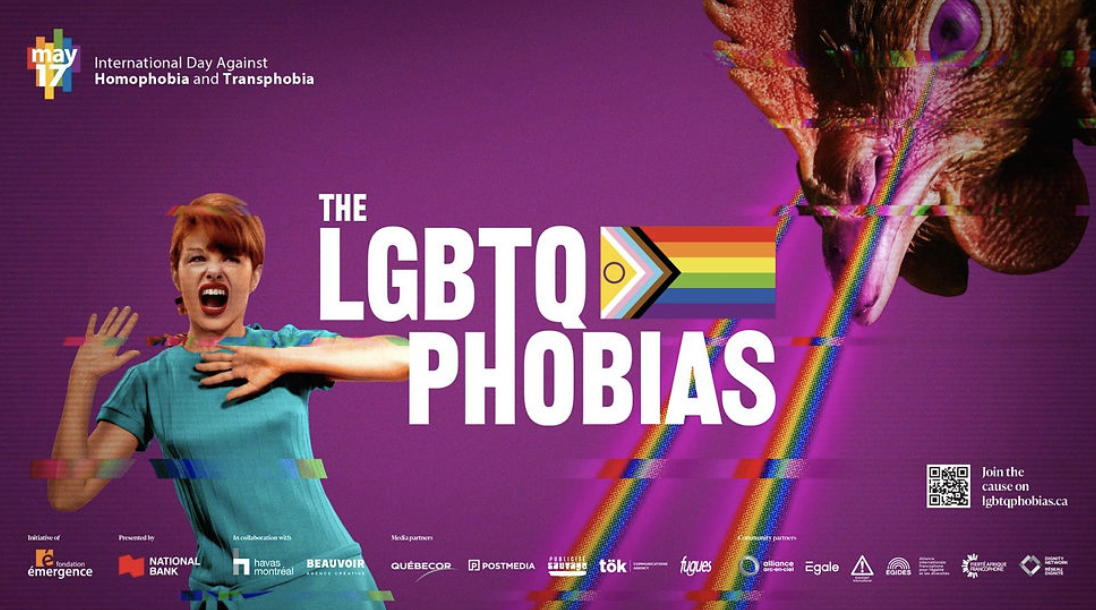
A poster humorously depicts anti-LGBTIQ hate as an irrational fear.
Absurdity has also been used in more serious campaigns.


“Leave with Pride,” a public campaign urging health authorities to take a stronger position against Conversion Practices, went viral. Activists led a social experiment, where queer volunteers filed for sick leave with their employers with a prescription from a doctor.
See “our special case study,” for more examples of campaigns against Conversion Therapies.